Moni & Kelimutu: Rain, Wrong Turns & Remarkable Views

Updated: Sep 12
As I sit on our balcony with a freshly brewed local coffee in hand, I'm struck by the soundtrack of everyday life. Children's chatter drifts through the valley, roosters announce themselves throughout the day, the occasional motorbike passes along the road below, and now and then a horn echoes in the distance.
Then... silence.

Not the silence of emptiness, but the peaceful kind that allows you to simply sit, listen and be present. It's one of the things we've come to love most about Flores - life feels unhurried, and somehow the simple sounds of everyday living become part of the experience.
Moni sits within the Lio (also written Li'o) cultural region, which occupies much of central Flores around Moni, Detusoko, Wolowaru, and Ende.
Getting to Know Moni
Moni sits within the Lio (also written Li'o) cultural region, which occupies much of central Flores around Moni, Detusoko, Wolowaru, and Ende.
One of the most fascinating aspects of Lio culture is its connection to Kelimutu.
Traditionally, the three crater lakes were believed to be the resting places of souls after death:
one for the souls of elders,
one for young people,
and one for those believed to have committed wrongdoing.
While the stories and beliefs surrounding Kelimutu have evolved over time, the mountain remains far more than a scenic attraction. For the people of Flores, it is a place of deep spiritual significance, where ancient traditions and modern faith continue to coexist.
For us, Kelimutu was the reason we'd chosen to base ourselves in Moni. The three volcanic crater lakes are undoubtedly the region's biggest drawcard and, after plenty of research, we knew this was one mountain that was well within our comfort zone. Unlike some of Indonesia's more demanding climbs, reaching the summit is surprisingly accessible — around a 25-minute winding ride from Moni to the entrance gate, followed by a short drive to the car park and an easy walk to the viewpoints.
But I'm getting ahead of myself.
Let's rewind to the very first day of our Flores motorbike adventure.

Filled with excitement, we rolled out of Maumere and pointed our bikes towards our first stop of the day, the small coastal village of Sikka. We had barely been on the road for 15 minutes when the climb into the hills began. First came a light drizzle, then within moments the heavens opened. So much for easing into the trip - it was already time to pull over and wrestle on the wet weather gear.
We couldn't help but laugh. The exact same thing had happened on the first day of our Sri Lankan tuk-tuk adventure. Surely this wasn't going to become our trademark way of starting a road trip? We hoped it wasn't an omen for the weeks ahead.
With the rain settling in, our riding style changed immediately. The excitement was still there, but now it was mixed with caution as we carefully navigated the increasingly slippery roads.
Around 30 kilometres east of Maumere, with a short detour from the Trans Flores Highway, lies the historic village of Sikka. We wound our way through quiet coastal communities before arriving at one of the region's most significant landmarks — the Old Sikka Church.

Built in 1899 under the guidance of Dutch Jesuit priest Father Yohanes Engbers, the church is a beautiful blend of European architecture and traditional Sikka craftsmanship. From the outside it appears modest, but stepping inside reveals just how special it is.

As we wandered around the grounds, a friendly young man named Stephano introduced himself and kindly offered to unlock the church so he could show us around. Before entering, we were respectfully asked to wrap traditional handwoven cloth around our waists to ensure our knees were covered.

Inside, the church was breathtaking. Massive multi-tiered teak columns rose to a soaring vaulted timber ceiling, while elaborate paintings of angels watched over the altar.

The Stations of the Cross lined the walls in beautifully detailed artwork, and high above us colourful stained-glass windows sat just below the roofline. Although the gloomy weather meant little sunlight filtered through, we could easily imagine how spectacular the church would look on a bright morning, with coloured light dancing across the timber interior.

Before leaving, we signed the guest book and happily made a small donation towards the church's upkeep.

Sikka is also renowned for its traditional ikat weaving, and several local women proudly displayed their beautiful handmade textiles. Under different circumstances we would have loved to spend more time browsing and chatting, but the rain had other ideas. It was our very first day on the road, and with several hours still ahead of us, our priority had become reaching Moni before darkness fell.

Back on the main road, we debated making the detour to Koka Beach. It's often described as one of Flores' most beautiful bays, but looking at the thick grey skies and relentless rain, we knew it wouldn't be showing off its best side. Reluctantly, we drove straight past, promising ourselves that sometimes it's better to leave a place unseen than to experience it under the wrong conditions.
As the kilometres rolled by, the coastline gave way to winding mountain roads. Every now and then the clouds would part just enough to reveal glimpses of the deep valleys below, but the surrounding peaks remained completely wrapped in mist. We knew incredible views were hiding somewhere beyond the cloud, but on this day they belonged entirely to our imagination.

By now, sightseeing had become secondary. Our focus was firmly fixed on the wet bitumen stretching out in front of us. Our gloves and fingers were soaked through, our fingertips wrinkled from hours in the rain, and our helmet visors seemed to collect water faster than we could wipe it away. More than once we found ourselves wondering if anyone had invented tiny windscreen wipers for motorcycle helmets.

As the kilometres slowly counted down — 30... 20... 10... 5... finally zero — we rolled into Moni, cold, soaked to the bone, and more than ready for a hot shower and a warm meal.

Finding our accommodation, Farilla Lodge, was thankfully easy after a long day on the road. Our host, Peter, greeted us with a warm smile and showed us to one of just two guest rooms, both perched above Moni with peaceful views across the village and the patchwork of rice paddies below.
The genuine Flores hospitality we'd already begun to experience continued immediately. Peter happily shared his recommendations for where to eat in town and, with a knowing grin, mentioned that Mopi's Restaurant down the hill often had live music that carried on into the evening. It wasn't a complaint—just a thoughtful heads-up so we wouldn't be wondering where the music was coming from later that night.

After hours of riding through cold rain, it was exactly the kind of warm welcome we needed.
It wasn't quite the picture-perfect first day we had imagined, but then again, the best adventures rarely begin exactly as planned.


After two days of cloud and rain, we finally woke to brilliant blue skies. Our hosts brought a fully cooked breakfast consisting of omelette, pancake, fresh fruit and a lovely cup of coffee.

This is it, we thought. Today was Kelimutu day. We confidently typed "Kelimutu" into Google Maps, fired up the bikes and set off in search of the famous tri-coloured lakes.

Only... something didn't feel quite right.
Within a few minutes I found myself wondering why Kelimutu seemed to be behind us rather than ahead. Then again, this is mountainous country where roads twist and double back on themselves, so I convinced myself Google probably knew better than I did.
It didn't.
Before long we found ourselves bouncing along a rough, rocky road that became progressively narrower and more uneven. The doubts crept back in, so we pulled over and asked a couple of local men. Through a combination of smiles, hand gestures, broken English and our very limited Bahasa Indonesia, we came away convinced we were on the right track.
So off we went again.

After dodging potholes, puddles and increasingly questionable sections of road, we pulled over on this bridge to check the map. Again.

As the road became even rougher, we couldn't help commenting how challenging this would be in the dark for all those visitors heading up before dawn to catch the sunrise over the crater lakes.
Still, something didn't add up.
We stopped again at a tiny roadside shop. "Kelimutu?" we asked hopefully.
"Yes, yes..." came the reply, accompanied by an enthusiastic point straight ahead.
Not exactly reassuring.
A few kilometres later we finally admitted what we'd both been thinking. We pulled over, zoomed right out on Google Maps and stared at the screen. Surely this couldn't be right.
Just then another local man stopped. This time, after a bit more enthusiastic pointing and laughter, the message was unmistakable.
"No... wrong way."
He motioned for us to follow him back towards the main road.
Relieved, we did exactly that, convinced we were finally heading in the right direction.
Until I looked across the valley.
There, carved dramatically into the mountainside, was the very same new road we'd been travelling on almost an hour earlier.
"What?"
Somehow we'd managed to ride in one enormous circle.
A few more bends later we rolled straight back into Moni... exactly where we'd started.
Nowhere near Kelimutu. Only one thing left to do - head to Mopi's for a coffee.

It was one of those travel moments that was equal parts frustrating and hilarious. Sometimes the best stories don't come from reaching the destination at all—they come from getting spectacularly lost along the way.
Day two brought our second attempt at reaching Kelimutu. After a little more research and a chat with our host over breakfast, we decided to change tactics. Instead of chasing sunrise, we'd enjoy a relaxed breakfast first and then make our way up the mountain. It sounded like a sensible plan.
This time, we made sure Google Maps was taking us in the right direction. With that small victory behind us, we wound our way up the mountain through an endless series of sweeping bends and tight hairpins. The higher we climbed, however, the more the world around us disappeared. Thick cloud rolled in until we were completely enveloped in it, reducing visibility to little more than a few metres ahead.

Eventually, the entrance gate emerged from the mist, where we were welcomed by a friendly park attendant. We asked the question that had been lingering in our minds: Was it worth continuing? Would we actually see the famous crater lakes in these conditions?
Drawing on his local knowledge, he gently suggested we save our visit for another day. The cloud, he explained, had been particularly dense and had lingered over the mountain for several days. It seemed like sensible advice from someone who knew Kelimutu far better than we did, so we turned around and headed back down the mountain, accepting that perhaps it just wasn't meant to be.

Or so we thought.
Later that day, we met a couple of travellers who had arrived at almost exactly the same time as us. Instead of turning back, they decided to wait for around half an hour. The cloud slowly lifted, revealing Kelimutu's three volcanic lakes in all their spectacular colours.
Ouch.
It was one of those travel moments that stings a little but also teaches you something valuable. Sometimes local knowledge is invaluable. Sometimes nature has other ideas. And sometimes, if you have the time, patience can be the best travel companion of all.
For the benefit of this blog I will add some images from the internet.
While simply soaking up the beauty of Moni was enough for us, there was one nearby attraction that was well worth the visit without demanding a strenuous hike. As we've mentioned before, approaching 60 means we've become much better at knowing our limits. Bad knees and a realistic view of our fitness mean we don't feel the need to tackle every challenging trek, and we're perfectly happy choosing experiences that suit us. Murundao Waterfall was exactly that.

These two lovely girls greeted us at the top of the waterfall, handing us each a walking stick to help with the steep descent — and, more importantly, the climb back up! From memory, we paid around 20,000 IDR each to enter the waterfall area.

The trail begins directly opposite Rainbow Café in Moni, making it incredibly easy to find. There's an unofficial entrance fee of 10,000 rupiah, which includes the use of a bamboo walking stick. After several days of rain, the concrete path was quite slippery in places, so the stick proved to be more useful than we'd expected.

Less than five minutes later, after a gentle downhill walk, we arrived at the waterfall. It was a peaceful little spot, complete with rustic bamboo bridges, crystal-clear flowing water and rocks just begging to be explored. We happily spent time hopping from rock to rock, taking in the scenery and enjoying the simple pleasure of being there.

Of course, I couldn't resist recreating one of my favourite movie moments, pretending to be Baby from Dirty Dancing practising her balancing steps before Johnny famously says, "Hey, Baby." Let's just say my performance was enthusiastic… whether it was as graceful is another story.

Where We Ate
With the big breakfasts at Farilla Lodge keeping us going for most of the day, we generally only needed a small snack before dinner.
And with the rain showing no signs of letting up, we weren’t particularly keen on venturing too far in search of somewhere to eat. Luckily, there was a little restaurant just a two-minute walk down the hill from the lodge - and after our first meal there, we had no reason to look anywhere else.
We ate there all three nights, choosing something different each time, and every dish was delicious. Even better, the prices were incredibly reasonable.
Sometimes the best finds are the ones right on your doorstep.
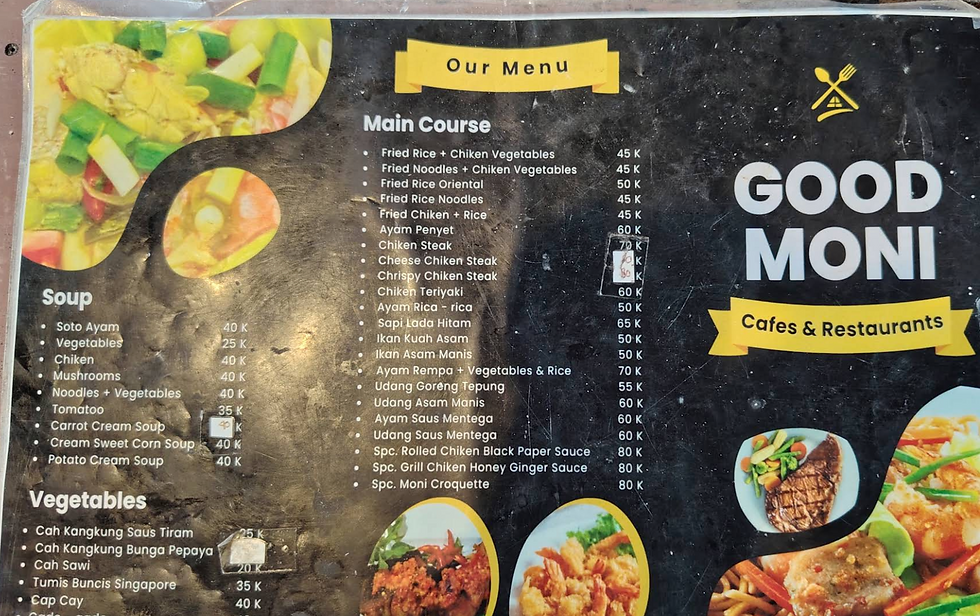
We did manage to squeeze in a visit to Mopi’s, where we shared half a hamburger for a late afternoon snack - and that was delicious too. Looking around at some of the other dishes coming out of the kitchen, we were a little disappointed we didn’t get the chance to come back for a proper meal. There were definitely a few things we would have loved to try!
Chasing Blue Skies to Ende
After two nights and three days in Moni, it was time to continue our journey west to Ende.
As we packed the bikes, there was one thing at the top of our wish list - blue skies. After spending much of our first ride across Flores cold and rain-soaked, we were hopeful that this leg of the journey would finally reveal the spectacular mountain scenery that had been hidden behind the clouds. We were ready to trade rain jackets for lighter layers and spend less time watching the road beneath our wheels and more time taking in the landscapes around us.
One thing we were quickly learning about Flores was to expect the unexpected. Every bend in the road seemed to reveal something different—a traditional village, a dramatic coastline, towering volcanic peaks or smiling locals waving as we rode past. We had no idea what surprises awaited us between Moni and Ende, but that uncertainty was becoming one of our favourite parts of travelling this island.

With the bikes loaded and our spirits high, we pulled back onto the Trans Flores Highway, eager to discover what the next chapter of Flores had in store.
See you in Ende!
Kev and Donna XOXO

Can't wait to see the rest of your motorbike adventure